


A weekly plan is not just a prettier to-do list. It is the moment when vague intentions become real decisions: what matters this week, what fits, what gets delayed, and where the work will actually happen. Without that step, most days become reactive. Email sets the agenda, small tasks expand to fill the afternoon, and important work keeps rolling forward unfinished. The point of a weekly planning routine is not to control every hour. It is to create enough structure that the week stops happening to you and starts reflecting your priorities.
- Plan the week, not just the day. Daily lists help, but weekly planning is where you make real tradeoffs.
- Start with capacity before ambition. Fixed commitments, energy, and available hours determine what a realistic week can hold.
- Choose a small number of weekly outcomes, then schedule the work that creates them.
- Leave buffer. A packed calendar looks productive and usually collapses by midweek.
- Use a short daily reset to adjust the plan instead of rebuilding it from scratch every morning.
Why weekly planning works better than constant daily replanning
Daily planning matters, but it works best as an adjustment tool, not the main strategy. The real problem for many people is not writing down tasks. It is deciding, in advance, which work deserves the week’s limited time and attention. Research on time management suggests that structured time management is associated with better performance and well-being, which helps explain why a deliberate weekly routine is often more useful than relying on motivation and memory alone. (journals.plos.org)
Weekly planning also reduces mental drag. One reason unfinished work feels so noisy is that the brain keeps rehearsing what has not been closed. In experiments, making specific plans for unfulfilled goals reduced intrusive thoughts and interference on unrelated tasks. Related research on implementation intentions shows that if-then style plans make goal pursuit more reliable than general intentions by linking a future cue to a specific action. That is why “work on proposal sometime this week” is weak, while “Tuesday at 9 a.m., draft the proposal outline” is much stronger. (pubmed.ncbi.nlm.nih.gov)
There is another benefit: fewer costly task switches. Research on attention residue shows that when people leave work unfinished and rush into the next thing, part of their attention stays stuck on the previous task. A brief plan for returning to the interrupted work can reduce that effect. In practical terms, a strong weekly routine does not just list priorities. It creates cleaner starts, cleaner stops, and less mental spillover between tasks. (pubsonline.informs.org)

Build a capacity-first week, not an aspirational one
The most useful weekly plans begin with reality, not optimism. A practical way to think about the process is what I’d call the Capacity-First Week. It has four layers. If one layer is ignored, the plan becomes fragile. If all four are present, the week is easier to execute and easier to adjust when life changes.
- Anchors: fixed commitments and maintenance activities such as appointments, commuting, childcare, workouts, sleep targets, and recurring meetings. These shape the week before optional work does.
- Capacity: the open time left after anchors. This is the real budget for discretionary work. Most planning failures begin when the budget is imaginary.
- Outcomes: a small set of end-of-week results that matter. Outcomes are clearer than vague efforts and more useful than a giant task dump.
- Blocks and buffers: calendar space for focused work, shallow work, transitions, and unexpected demands. A plan that leaves no slack is not ambitious. It is brittle.
A useful starting rule is to plan only about 60 to 70 percent of your discretionary time. The rest absorbs interruptions, overruns, and lower-energy stretches. If your job is highly reactive, even more buffer may be necessary.
A 45-minute weekly planning routine that is realistic enough to keep using
Set one recurring appointment with yourself each week. Friday afternoon works well for some people because the previous week is still fresh. Sunday evening works well for others because it creates a clean start. The exact timing matters less than consistency. What matters is that the session has a repeatable sequence, ends with an actual calendar, and produces a plan you can see all week.
- Collect every task, reminder, and loose commitment into one place.
- Review the previous week for carryover, deadlines, and lessons.
- Choose three to five weekly outcomes.
- Triage the remaining tasks before they crowd the calendar.
- Block real work time for the outcomes that matter most.
- Add buffer and brief restart notes for interrupted work.
- Run a 10-minute daily reset instead of rebuilding the plan each morning.
1. Empty your capture points before you prioritize
Start by gathering everything that is trying to occupy mental space: email follow-ups, sticky notes, Slack messages, notes from meetings, household errands, personal admin, and ideas you scribbled during the week. The goal is not to organize perfectly yet. It is to stop planning from fragments. A weekly session cannot produce clear decisions if half the commitments are still hiding in different apps and notebooks. One inbox is usually enough. More than one is manageable only if there is a reliable review habit behind it.
2. Review the last week before you design the next one
Look back at last week’s calendar and task list. What was completed? What slipped? What took longer than expected? Which commitments are still active? This is where weekly planning becomes diagnostic rather than decorative. Repeating the same unfinished task for three weeks is a signal. The task may be too large, too vague, too low-value, or dependent on someone else. Do not simply drag it forward again. Decide why it moved, then change something: shrink it, schedule it differently, delegate part of it, or delete it.
3. Choose weekly outcomes, not just activity
Now decide what would make the week feel meaningfully advanced by Friday. For most people, three to five outcomes is enough. More than that usually signals that the plan is becoming a wish list. An outcome is a visible result: submit the proposal draft, finish the budget review, book the dentist appointment, prepare Monday’s presentation, clear the paperwork for the trip. The wording matters. “Work on report” is not specific enough to drive scheduling. “Draft sections one and two of the report” is. This is also a good place to separate must-finish items from should-advance items. Not every priority deserves equal status.
| If the task is… | What to ask | Best move this week |
|---|---|---|
| High impact and time-sensitive | Will delay create real cost, stress, or blockage for someone else? | Schedule a protected block early in the week. |
| Important but too large for one sitting | What is the smallest visible milestone? | Shrink it into a concrete next action and give that action time on the calendar. |
| Useful but optional | Does it serve a current goal or is it lingering guilt from another season? | Move it to a later list instead of stuffing it into this week. |
| Delegable or shareable | Does quality truly require you to do the whole thing yourself? | Delegate, collaborate, or schedule only the oversight step. |
| Recurring admin | Can several similar tasks be handled together? | Batch them into one shallow-work block. |
| Lingering without consequence | What happens if it is not done this month? | Delete it. |
Notice what this table does: it forces subtraction before scheduling. That is one of the main differences between productive planning and performative planning. A good weekly plan is not the one that remembers every possible task. It is the one that protects the few things that matter and clears space around them.
4. Put the work where it can actually happen
Only after triage should you start time-blocking. A useful sequence is to place non-negotiables first, then fixed commitments, then the specific work blocks that support your weekly outcomes. Guidance from Stanford’s Center for Teaching and Learning follows this basic order and also recommends considering when your energy is strongest. Oregon State similarly emphasizes using a weekly schedule, aligning work with your best conditions, and keeping the schedule visible. Even though those resources are designed for students, the structure transfers well to professional and personal planning. (ctl.stanford.edu)
In practice, that means the hardest work should usually land in your best focus windows, not in whatever time remains after meetings. It also means large tasks need smaller appointments. “Report” does not go on the calendar. “Tuesday 9:00 to 10:30 a.m.: draft analysis section” goes on the calendar. Admin blocks deserve their own place as well. If email, invoices, travel booking, and forms always leak into focus time, give them a home instead of pretending they do not exist.

5. Add buffer and restart cues so the plan survives interruptions
Most people know they need buffer, but few people define it. Add blank space between demanding blocks, preserve at least one lighter catch-up window, and avoid stacking every important item in the back half of the week. Then create simple restart cues. At the end of a work block, write one line: what was finished, what the next step is, and what document or file to open first. This mirrors the logic behind the ready-to-resume intervention in attention residue research: a brief return plan helps the mind let go and restart more cleanly later. (pubsonline.informs.org)
6. End with a daily reset rule, not a second planning system
Weekly planning does not eliminate daily adjustment. It eliminates daily reinvention. Spend 10 minutes at the end of each day checking tomorrow’s blocks, moving unfinished items, and preparing the first meaningful task. If a block has resistance around it, make an if-then plan. For example: “If it is 8:30 a.m. on Wednesday, I open the spreadsheet and reconcile the first ten entries before checking messages.” That kind of cue-action pairing is exactly what implementation intention research is about. (socmot.uni-konstanz.de)
What this looks like in a real week
Consider a hypothetical example. A project coordinator ends Friday with a half-finished client deck, a budget review due Thursday, several personal errands, and a calendar already crowded by meetings. Without a weekly routine, all of it would sit on one anxious task list. With a weekly routine, the work becomes structured decisions.
- Outcome 1: finish and send the client deck by Tuesday afternoon.
- Outcome 2: complete the budget review draft by Thursday noon.
- Outcome 3: schedule two medical appointments and pay one overdue bill.
- Outcome 4: prepare materials for Friday’s team check-in.
From there, the coordinator blocks two focused sessions on Monday for the deck, one Wednesday morning session for the budget review, a 45-minute admin batch on Wednesday afternoon for personal paperwork, and a short prep block on Thursday for Friday’s team meeting. Friday afternoon remains partially open as recovery space for anything that slips. The week is not easier because there is less to do. It is easier because the tradeoffs have been made early, in one place, before the busiest moments arrive.
The mistakes that quietly ruin a weekly planning system
A weekly routine usually breaks down for ordinary reasons, not dramatic ones. These are the failure patterns worth watching for.
- Planning every task at the same level. A strategic project, a routine email, and a grocery run do not deserve identical treatment.
- Confusing motion with progress. A full list of tasks can still leave the most important outcome untouched.
- Overbooking the calendar. If every open hour is claimed, the plan collapses the first time a meeting runs long or energy dips.
- Treating the calendar as optional. If important work lives only on a task list, urgent work will usually beat it.
- Rolling tasks forward without diagnosis. Carryover is information. Repeated carryover points to vagueness, avoidance, bad estimates, or lack of real value.
- Switching tools instead of fixing decisions. Most productivity problems are not caused by the planner, app, or notebook. They are caused by weak prioritization and unrealistic capacity assumptions.
If weekly planning regularly creates guilt instead of clarity, the problem is usually not discipline. It is a mismatch between ambition and capacity.
How to adapt the routine when your week is unpredictable
Not every job or season of life supports long, elegant focus blocks. Managers, caregivers, support staff, healthcare workers, freelancers, and people in highly reactive roles may deal with interruption-heavy days. That does not make weekly planning useless. It changes what the plan should optimize for. Instead of perfect execution, the plan should protect critical outcomes, preserve recovery, and create fast ways to restart after disruption.
- Use shorter blocks. Thirty to sixty minutes may be more realistic than two-hour deep-work sessions.
- Protect only one or two must-win blocks per week if your schedule is volatile. Small protection is better than imaginary protection.
- Keep a dedicated catch-up block and one emergency list. That prevents reactive work from scattering everywhere.
- Run a midday check on especially chaotic days. In reactive roles, one weekly review plus a brief midday reset may work better than relying on the weekly plan alone.
There are also seasons when productivity should not be measured by output alone. Travel weeks, illness, family disruption, or intense launch periods may call for maintenance planning rather than ambitious planning. The routine still works, but the objective changes from maximizing progress to preventing avoidable chaos.
The routine is simple, but the judgment inside it matters
The best weekly planning routine is not the one with the most categories, colors, or rules. It is the one that helps you make better decisions before the week gets loud. Start with reality. Limit the number of outcomes. Put important work on the calendar. Leave room for life. Then adjust daily without abandoning the plan. If that becomes a steady habit, productivity usually feels less like pressure and more like direction.
What is the best day to do weekly planning?
Any recurring time can work, but it should be attached to a natural transition. Friday afternoon is useful for review while the week is still visible. Sunday evening is useful for setup before Monday begins. Pick the slot you are most likely to keep consistently.
How many weekly priorities are too many?
If every item feels equally important, there are too many. For most people, three to five weekly outcomes is a workable range. You can still keep a longer list of secondary tasks, but the calendar should mainly protect the few outcomes that would make the week feel meaningfully complete.
Should a weekly plan live in a paper planner or a digital app?
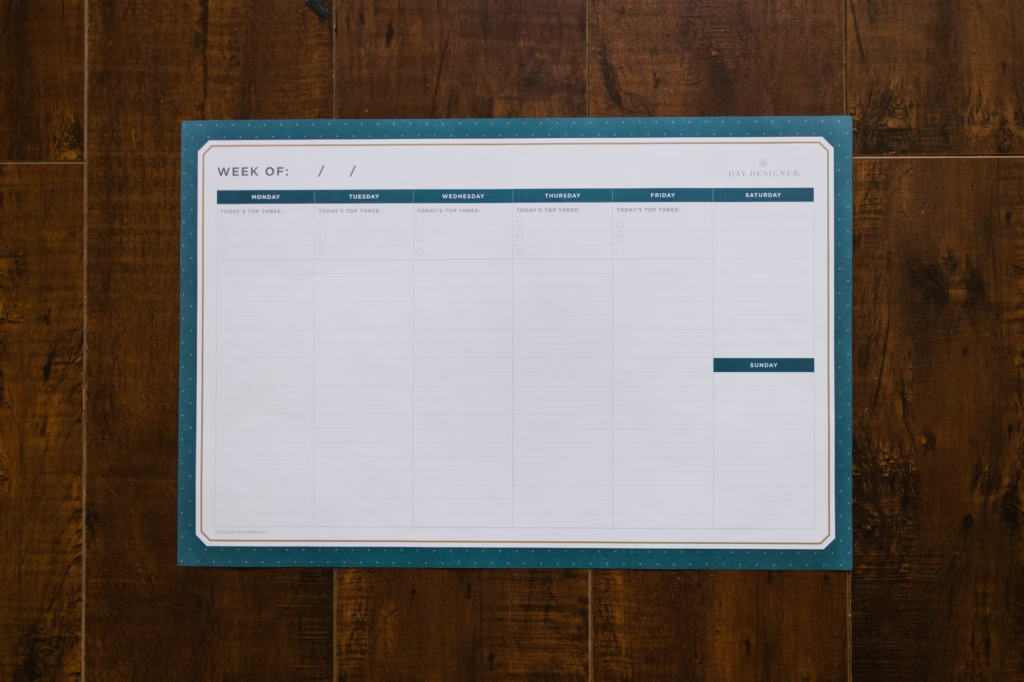
Use the tool that you will review reliably. Paper is often excellent for focus and visibility. Digital calendars are better for reminders, recurring events, and schedule changes. Many people do well with a hybrid system: tasks captured in one trusted place, calendar blocks scheduled digitally, and weekly outcomes written where they stay visible.
What if the week falls apart by Tuesday?
Do not throw out the system. Replan from the current reality. Identify what is still essential, what can move, and what should be dropped. A weekly routine is not evidence that disruption will not happen. It is the structure that makes midweek recovery faster and less emotional.
Do I need to schedule personal time too?
Usually, yes. If exercise, family commitments, errands, meals, or downtime are treated as optional, work tends to consume their space. Scheduling personal anchors first also makes the rest of the week more honest, because you are planning around a real life instead of an imaginary one.
References
- Aeon, B., Faber, A., & Panaccio, A. (2021). Does time management work? A meta-analysis. PLOS One. – https://journals.plos.org/plosone/article?id=10.1371%2Fjournal.pone.0245066
- Masicampo, E. J., & Baumeister, R. F. (2011). Consider it done! Plan making can eliminate the cognitive effects of unfulfilled goals. – https://pubmed.ncbi.nlm.nih.gov/21688924/
- Gollwitzer, P. M., & Sheeran, P. (2006). Implementation intentions and goal achievement: A meta-analysis of effects and processes. – https://www.socmot.uni-konstanz.de/publications/implementation-intentions-and-goal-achievement-meta-analysis-effects-and-processes
- Leroy, S., & Glomb, T. M. (2018). Tasks Interrupted: How Anticipating Time Pressure on Resumption of an Interrupted Task – https://pubsonline.informs.org/doi/pdf/10.1287/orsc.2017.1184
- Stanford Center for Teaching and Learning. Weekly Planning: Time Blocking Method. – https://ctl.stanford.edu/weekly-planning-time-blocking-method
- Oregon State University Academic Success Center. Strategies for Creating an Effective Weekly Schedule. – https://success.oregonstate.edu/learning-corner/planning-time/weekly-schedule