

While multiple studies report that frequent short breaks can help combat feelings of fatigue, only a handful study whether breaks improve the quality or speed of work. The distinction between the two is fairly important. In my opinion, breaks should be taken when employees feel fatigued. Breaks should not be taken simply to meet a deadline or to adhere to a time constraint. Breaks should not be taken to cut an interruption into a long stretch of uninterrupted productivity.[1]
A tradeoff has to be made when mistakes start to accumulate, or when breaks turn into answering messages. A better balance needs to be made between adhering to the timer and producing work that makes employees miserable.
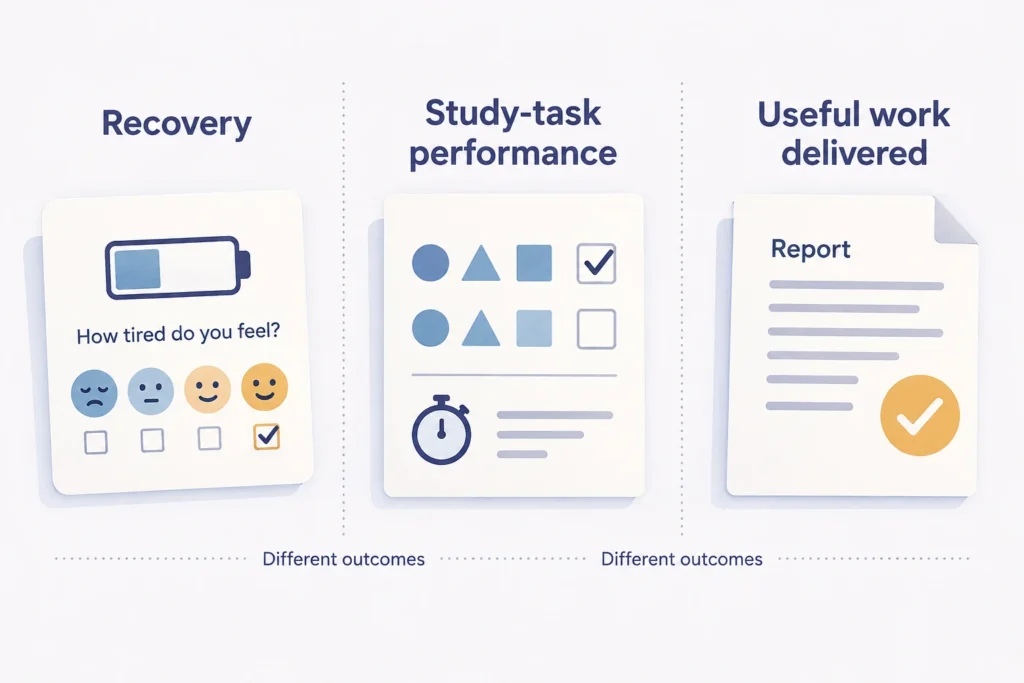
Feeling better isn’t the same as performing better
A 2022 meta-analysis combined 22 samples involving 2,335 participants. Micro-breaks produced small improvements in fatigue and vigor, feeling less worn out and more energetic, but no statistically significant improvement in overall performance. About half the studies used students, and the outcomes were short-term. That’s useful evidence about recovery, not proof that professionals deliver better work across months of ordinary workdays.[1]
The results also depended on the category of the task being performed. Benefits were statistically significant for creative and clerical tasks. No such benefits were reported for cognitive tasks. Improvements for clerical tasks were drawn from just two studies. Again, these categorizations shouldn't be drawn to make sweeping generalizations like "designers need breaks" or "analysts don't."[1]
Feeling less tired and scoring better on a task can occur separately. Similarly, accuracy, speed, and task completion are not the same. Just because the overall result is not significant does not mean that breaks never help or that performance would not be the same over the course of a longer day without breaks. “Breaks boost productivity” is a better promise than what this evidence shows.[1]
Momentum depends on what you’re holding together
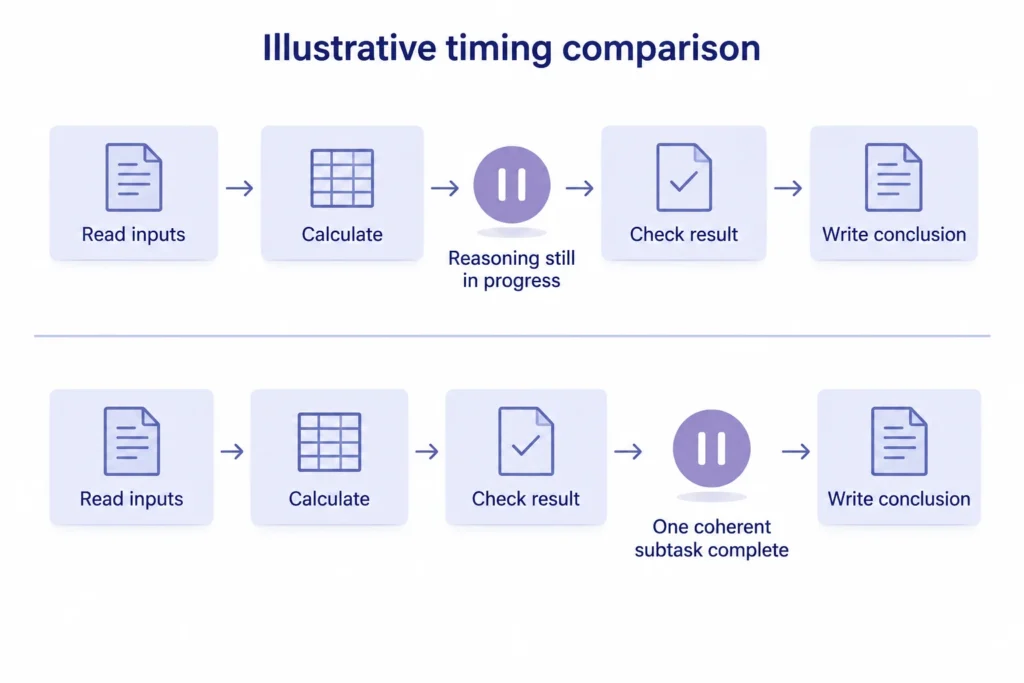
Let’s say, in a hypothetical situation, I am comparing two budget estimates when my break timer goes off. I have just spotted why the totals are different, but have not yet confirmed the correction. Irritated, I finish that confirmation and leave a line to indicate what I have just done. I then take a break, not after doing the entire report, just after doing this line of reasoning.
There’s somewhat related evidence to say that we should take the stopping point seriously. In one experiment, university students were planning trips and were interrupted to answer a series of questions. It was found that the larger the tasks the students were interrupted in, the more time it took to resume work and the lower the workload. This research, however, is different from a direct observation of breaks during work.[3]
It’s best to find a nearby, significant stopping point. Checking a calculation, completing a comparison, and finishing a section of a report are all examples of good stopping points. Don’t stop and walk away after doing only a small part of a large, overall task. Protecting “momentum” might mean losing productivity in a longer, overall, uninterrupted period of work.
The research doesn’t give you a magic interval
According to the 2022 meta-analysis, micro-breaks are defined as breaks of ten minutes or less. Longer breaks are related to larger performance effects in the studies reviewed. Neither definition or review provides an optimal break length. The authors argued a 10-minute break is a 'category' break, and longer breaks should be tested in a more controlled environment.[1]
Frequency matters alongside length. An experience-sampling study of 95 employees over five workdays associated earlier breaks and preferred activities with greater reported recovery. Length and frequency interacted: longer breaks and frequent short breaks compared favorably with infrequent short breaks. I wouldn’t turn that into a calendar prescription. The study was observational, so it couldn’t establish which schedule caused better recovery.[2]
What happens during the pause, and who gets to choose
I’d start with something you actually find restful, rather than a supposedly superior activity you dislike. The employee study supports taking preference seriously, but it doesn’t establish a universal ranking of walking, talking, sitting quietly, or using your phone. Answering work messages is also worth distinguishing from pausing work: you may have changed tasks without getting the respite you wanted.[2]
Your phone isn’t automatically disqualified as a break, either. A September 2026 review of 54 studies found that some non-work digital activities can support recovery, with differences involving the experience, affect, and duration of use. It covered both at-work and off-work settings, so I wouldn’t take it as proof that scrolling between tasks improves your output.[5]
Movement has some encouraging but limited evidence. A July 2026 meta-analysis of 21 randomized crossover trials involving 433 participants found small acute executive-function and memory benefits from interrupting sitting with standing or activity, but no clear attention benefit. Evidence certainty was low or very low. Those cognitive-test results don’t tell you whether a report gets better, or whether the gains outweigh break and restart time across your workday.[6]
Choosing the timing isn’t automatically better, either. A one-day study of 87 university students compared self-regulated breaks with 24-minute study/6-minute break and 12-minute study/3-minute break schedules. Scheduled groups reported some better task experiences, but not greater task completion. Completion was self-reported, tasks varied, and attrition limited analysis to the first day. Participants described both refreshment and disruption, a useful reminder that the same structure can help and get in the way.[4]
If you’re using a timer to break up your work, and you find it interrupts your work, it may be better to use it to set a reminder to take a break. Liking an activity, choosing its timing, and having workplace permission to stop are separate issues. There may be some reasons to always be accessible, like customer service, and breaking it up may help. A more elaborate plan may help you take a break, but it may not help be consistent with what others expect of you.
Notice whether it fits, without building a dashboard
If you're still unsure, try making a small change to your routine during a few similar work sessions. Keep the following observations separate:
- Comfort: Did the pause ease fatigue or discomfort?
- Errors: Were you catching mistakes, or repeatedly making avoidable errors?
- Useful progress: Did you make progress toward a usable result, or were you just working on the result?
- Restarting: Were you able to return to the work easily, or did you lose your place?
Less fatigue with no change in output is a good result. If returning is the problem, I would first try stopping at a different place or taking a next action note. If pausing doesn't give relief, then try changing your activity or increase the time you allot for the break. This doesn't mean you've failed at resting. It could also help you identify what does give you relief. Remember, difference in what you're working on, the difficulty level of the task, and how rested you are mean this isn't a good control to determine what the break does.
You don't need to audit every break. Keep a comfortable, productive stretch of time when it's really working. A break doesn't always need to make up time to give you relief.
Sources and references
- PLOS ONE: “Give me a break!” A systematic review and meta-analysis on the efficacy of micro-breaks for increasing well-being and performance (2022-08-31)
- Journal of Applied Psychology; PubMed: Give me a better break: Choosing workday break activities to maximize resource recovery (2015-08-10)
- Human Factors; SAGE: Examining the Effect of Interruptions at Different Breakpoints and Frequencies Within a Task (2021-04-16)
- British Journal of Educational Psychology; Wiley: Understanding effort regulation: Comparing ‘Pomodoro’ breaks and self-regulated breaks (2023-03-01)
- International Journal of Management Reviews; Newcastle University repository: Engaging in Non-Work-Related Information and Communication Technology (ICT) Activities for Work Recovery: A Systematic Literature Review (2026-09-10)
- International Journal of Behavioral Nutrition and Physical Activity; PubMed Central: Acute cognitive effects of interruptions to prolonged sitting with brief standing or physical activity breaks: a systematic review and three-level meta-analysis (2026-07-13)