


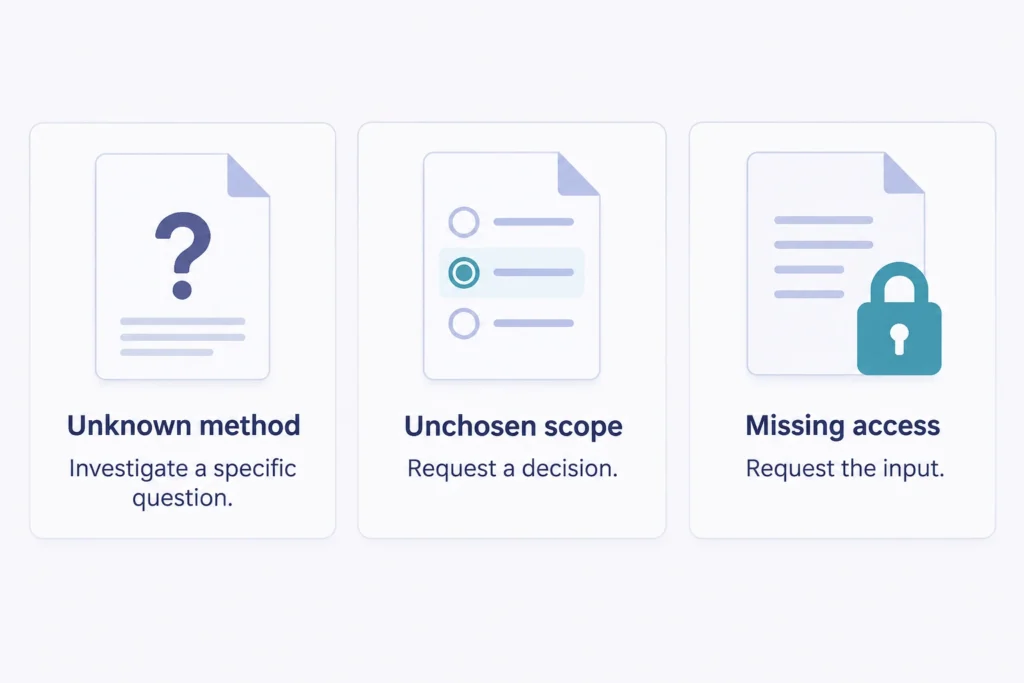
Determine what moves you: a question you can explore, a choice someone else has to make, or an input you can’t supply. State the question or choice/input and the point at which you’ll stop exploring. I wouldn’t make a detailed task list around a direction nobody has chosen.
More information won’t settle every kind of uncertainty
The question I’d use is “if I had this answer, could I proceed within my authority?” Not knowing how to improve onboarding is different from not knowing if the assignment concerns customers vs. employees. Not knowing the records you need won’t help if you can’t access them.
Picture me, in an imagined example, opening an assignment called “Improve onboarding.” I’ve collected six articles, but the shared folder contains both customer tutorials and employee checklists. I’m irritated that my afternoon looks busy while the assignment remains untouched. Instead of opening another article, I ask which audience this project serves. That answer changes what’s worth investigating.
When you know the outcome but not how to reach it, “find a promising approach” can be a useful immediate goal. Research on learning versus performance goals distinguishes discovering effective strategies from applying skills you already have. I wouldn’t mistake that need to learn for a need to try harder. But learning won’t supply missing approval or access.
Give research a job, and an exit
Once customer onboarding is confirmed, “research onboarding” is still too loose. A good next question relates evidence to a possible next step. The Federal government’s discovery guidance embraces this approach. Exploration has a purpose, and ends with a decision to move forward, which can include stopping. For a small assignment, I’d define this decision like this:
- Question: Is there a specific setup obstacle worth investigating next?
- Evidence: Review the most recent support-related documents for the onboarding activity, and the current version of the setup guide.
- Output: A brief note stating a possible candidate next step, supporting evidence, and what remains unknown.
- Exit condition: If multiple documents point to the same unclear component of the system, draft a possible revision for review. If the documents point to other components, state the next question.
- Effort ceiling: Spend up to one work session on this first draft, and explain what it did and did not address.
The work session and repeated examples used to set the scope are a starting point for adjusting the scope. A few documents might lead to drafting a possible adjustment for the system, but they will not explain the cause or scope of the issue. An empty search may reveal a lack of visibility rather than a trouble-free system.
Before spending additional time, name the finding that would inform the next step. If you cannot state this, I would refer the unanswered question to the person who defined the scope rather than continuing to gather evidence. Evidence may support drafting a possible adjustment to the system, but may not support a major release.
Ask for the choice, not “some guidance”
Give the recipient a choice they can actually answer. Define decision criteria and prescribe a timeframe to make a decision on issues the owner can’t resolve. This may sound like the following: “Should this cover customer setup or employee onboarding? We have customer support records. Employee onboarding needs HR. I recommend customer setup, if reducing support demand is the goal. Audience-specific drafting is paused until we decide. Can you decide by Thursday, or name someone who can?”
When you don’t have the access you need, request it: “I need read access to onboarding support records to identify a candidate obstacle. Can you provide that, or name someone who can, by Thursday?” Keep a single line next to your work, identifying the missing item, who is responsible, what work is effected, and when you will follow up next. This is a lightweight adaptation of the guidance to have controls in proportion to the risks and dependencies. If there’s no owner, name someone who can assign, give, or take away responsibility.
You may be able to find work that you can do in the interim, under either possible choice. There may be work that quiet commits everyone to your preferred answer. You can prepare another person to make a decision, even if that decision is beyond your authority. You can make assumptions, but don’t treat silence as approval.
You can still give a straightforward update to a sponsor, even if a direct request went unanswered. “X is no longer an issue of concern; Y is the issue; and Z can proceed” is a good update. I’d rather see that than lots of unnecessary notes.
Sources and references
- Academy of Management; full text hosted by Western Kentucky University: Learning versus performance goals: When should each be used? (2005-02-01)
- UK Government Service Manual: How the discovery phase works (2016-08-04)
- UK Government Project Delivery: Government Functional Standard GovS 002: Project delivery, version 2.1 (2025-09-01)