

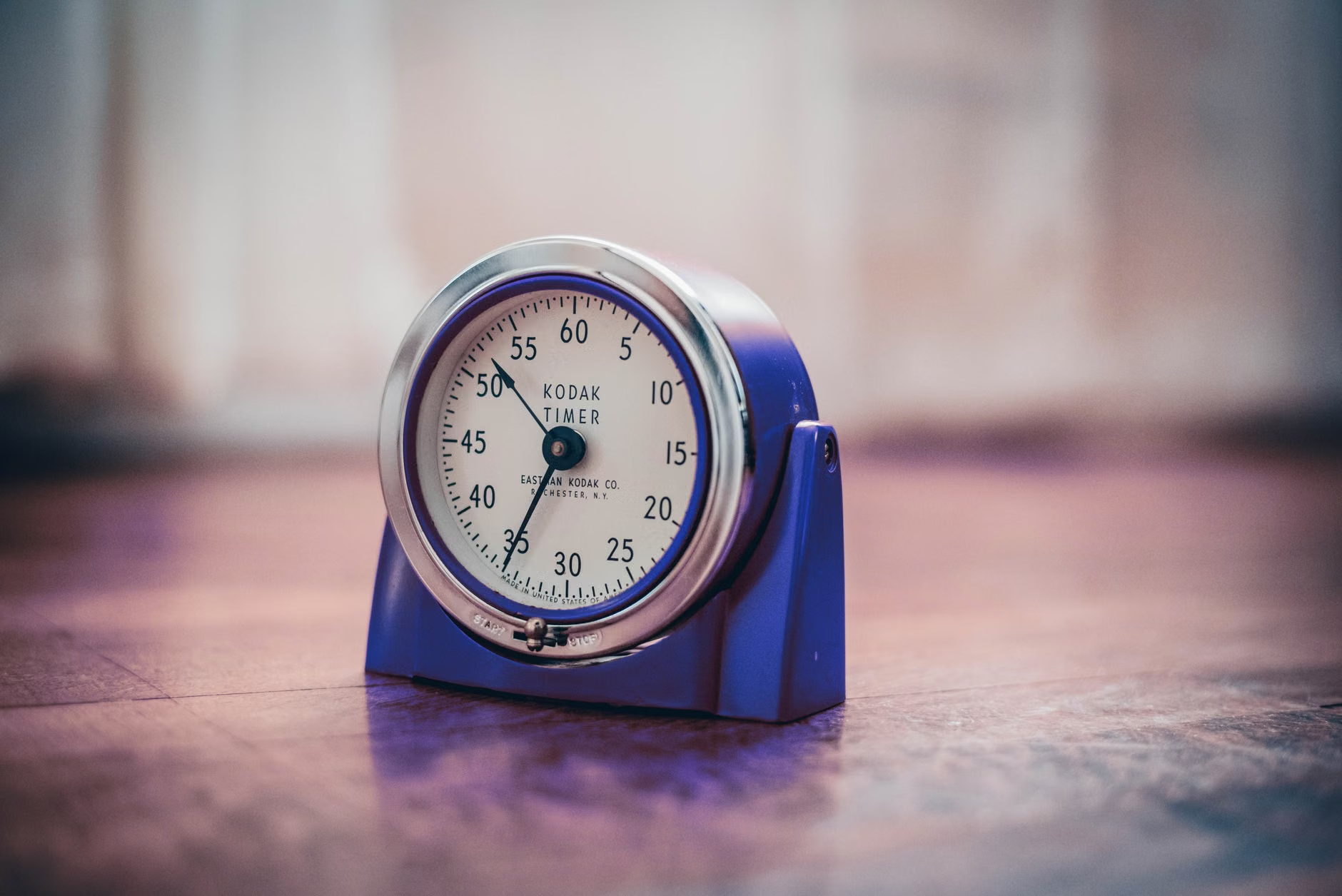
The Pomodoro Technique has lasted longer than most productivity trends for a simple reason: it solves a real problem. Many people do not need another inspirational quote or a more colorful to-do list. They need a way to begin, stay with one thing, and stop before a workday dissolves into tab-switching, fatigue, and vague guilt about not getting enough done.
That does not mean the internet version of Pomodoro gets everything right. The method is often sold as if 25 minutes of work followed by 5 minutes of rest were a scientifically perfect formula. The evidence is more modest than that. Pomodoro can improve productivity when the bottleneck is task initiation, distraction, or pacing. It is much less reliable when the work depends on long uninterrupted flow, constant collaboration, or unpredictable interruptions. In other words, it is a useful tool, not a law of human focus.
TL;DR
- Pomodoro is usually better at improving start-up, consistency, and pacing than at magically increasing output in every kind of work.
- Research on breaks is supportive but mixed: short breaks often help fatigue and well-being, while performance gains are smaller and less consistent.
- There is no strong evidence that 25 minutes on and 5 minutes off is the best schedule for everyone.
- The technique works best when tasks are clearly defined and easy to measure in small chunks.
- If the timer keeps interrupting genuine deep focus, the method should be modified rather than obeyed mechanically.
What the Pomodoro Technique actually is
Francesco Cirillo developed the technique in the late 1980s while trying to improve his own study habits with a tomato-shaped kitchen timer. The familiar public version is simple: choose one task, work for a set interval, take a short break, repeat, and after several rounds take a longer break. But the official Pomodoro materials make an important point that casual productivity advice often misses: the technique is not just a timer ritual. It also includes daily planning, interruption management, and estimating how much effort work really takes.
- Pick a specific task, not a vague intention such as “work on project.”
- Set a timer for one focused interval. The popular default is 25 minutes with a 5-minute break.
- Work on that one thing without switching, checking messages, or expanding the task mid-session.
- Record the interval so you can compare planned effort with actual effort.
- After several rounds, pause longer, then review what changed, what got interrupted, and what still needs attention.
That broader structure matters. A timer by itself can create urgency, but the planning and tracking pieces are what make Pomodoro useful over time. They force a reader, student, manager, or knowledge worker to convert fuzzy ambition into something observable: one block for outlining, two blocks for revision, one block for problem sets, three blocks for reconciliations, and so on. That move from feeling busy to seeing actual work units is one of the technique’s real strengths.
Why Pomodoro often feels effective even before you measure it
First, it lowers the cost of starting. A task that feels oppressive at the scale of “finish the report” can feel manageable at the scale of “do 25 clean minutes.” That is especially useful for avoidance-heavy work such as studying, drafting, admin cleanup, or any project with a lot of emotional resistance before the first real step.
Second, it creates a clear boundary around attention. A timer says this is not the hour for email, random searching, or polishing side issues. Even when the interval is imperfect, the boundary itself can be valuable because it stops work from constantly renegotiating with every nearby distraction.
Third, it adds recovery on purpose. Many people are less harmed by hard work than by shapeless work that goes on too long. A short break can reset posture, eyes, and mood before mental sloppiness starts to masquerade as diligence. That does not guarantee better output, but it can make sustained effort feel less draining.
A common misconception is that Pomodoro is about maximizing the daily count of completed intervals. That is too narrow. The creator’s own materials emphasize awareness, planning, and interruption control, not chasing a timer score.

What the evidence actually says about productivity
The first thing to know is that direct research on the Pomodoro Technique itself is still limited. A 2025 study comparing self-regulated, Pomodoro, and Flowtime break-taking among students noted that Pomodoro is widely recommended even though it has received surprisingly little direct attention in education research. That alone should make readers skeptical of sweeping claims that the technique is proven in a universal sense.
The broader research on breaks is more substantial, and it points to a more nuanced conclusion. A 2022 systematic review and meta-analysis on micro-breaks found small benefits for vigor and fatigue reduction, but not a statistically significant overall performance gain across studies. The same paper also found that longer breaks tended to be associated with larger performance boosts. Another 2022 systematic review concluded that break research is highly varied in break length, timing, task type, and outcomes, which makes one-size-fits-all prescriptions difficult.
When researchers test Pomodoro-style schedules more directly, the results stay mixed. A 2023 study on effort regulation compared self-regulated breaks with two structured break schedules, including a 24-minute study block followed by a 6-minute break. The structured conditions showed some advantages in fatigue, distraction, and mood, but not clear gains in task completion. A 2025 study of 94 students found that Pomodoro breaks were linked to a faster rise in fatigue and a faster drop in motivation than self-regulated breaks, yet there were no overall differences in productivity, task completion, or flow. A July 2026 study comparing systematic short Pomodoro-style breaks with self-regulated breaks likewise found no significant learning advantage for the fixed schedule, while self-regulated breaks produced more positive mood states.
That does not mean structured breaks are useless. A small 2023 experiment using a simulated work task found that most participants completed more work when 5-minute breaks were scheduled every 20 minutes than when breaks were left unstructured. CDC and NIOSH guidance also supports periodic rest breaks and posture changes, and cites reduced discomfort and eyestrain when hourly 5-minute breaks are added to conventional rest breaks. The most defensible reading is this: deliberate breaks can help people stay steadier and less depleted, but the evidence does not support a universal claim that a 25/5 schedule is the best way to maximize output for everyone.
| Task or work pattern | How standard 25/5 usually fits | Better move |
|---|---|---|
| You keep procrastinating on a clearly defined task | Strong fit | Use a standard Pomodoro or even a shorter starter block such as 15/3 to create momentum |
| Shallow or administrative work tends to sprawl all day | Good fit | Batch similar tasks and use timed intervals to cap drift and prevent perfectionism |
| Deep writing, coding, design, or research synthesis needs warm-up time | Mixed fit | Try 40/10 or 50/10, or stop at a natural breakpoint instead of at the bell |
| Your role is highly reactive with chats, calls, clients, or caregiving interruptions | Weak fit | Use protected focus windows or calendar blocks rather than a repeating timer |
| Long desk work leaves you physically stiff or mentally blurred | Helpful for pacing more than raw output | Keep the break active: stand, walk, stretch, hydrate, and look away from the screen |
That table points to the central issue: Pomodoro is really a task-fit question. The technique is strongest when the work benefits from structure and frequent recommitment. It weakens when the work depends on extended immersion or when the environment is too interruption-driven for small repeated blocks to survive intact.
Use the Friction, Flow, and Feedback fit check
Before deciding whether Pomodoro belongs in a routine, use this simple fit check. It is not a scientific instrument. It is a practical editorial test for choosing a work rhythm that matches the task in front of you.
- Friction: Is the hardest part getting started? If the task is clear but resistance is high, Pomodoro often helps because it shrinks the psychological entry cost.
- Flow: Does the task get better after 30 to 40 minutes of uninterrupted immersion? If yes, a rigid 25-minute stop may cut off the very state that produces your best work.
- Feedback: Can you tell whether one block accomplished something real? If progress is visible in small units, the method works better. If not, the task probably needs to be broken down first.
A useful decision rule is to look for two out of three. If friction and feedback are high, Pomodoro is usually worth testing. If friction is high but flow is also high, use the timer only to start and then lengthen later blocks. If feedback is weak, do not blame the technique yet; rewrite the task into something concrete before deciding the method failed.

How to test Pomodoro for a week without fooling yourself
- Choose one type of work to test, such as studying, writing, invoicing, coding, or reading, instead of trying to apply Pomodoro to your entire life at once.
- Define success before you begin. That might be pages drafted, practice problems completed, tickets closed, or simply minutes spent on one task without switching.
- Pick an interval that matches the work. Start with 25/5 only if you have no strong reason to choose differently.
- Protect the break. Leave the screen if possible. Stretch, walk, refill water, or look outside. Avoid email and social feeds if the goal is recovery.
- Track interruptions separately from the task itself. If three people break the session or your phone keeps dragging you away, that is an environment problem, not proof that you lack discipline.
- Review after five workdays. Did you start sooner, finish more defined work, feel less depleted, and resume more easily after breaks? Keep the method only if those answers are mostly yes.
A hypothetical example makes this clearer. Someone drafting a report may find that Pomodoro cuts through perfectionistic stalling because each interval has a visible finish line. That same person, on a different day, may be doing conceptual planning that only becomes coherent after 35 minutes of uninterrupted thought. On the first task, the timer is useful structure. On the second, it may become the interruption. That is not inconsistency. It is normal task variation.
The most common ways Pomodoro backfires
- Counting intervals instead of outcomes. Four Pomodoros spent reorganizing a document are not automatically better than one uninterrupted hour that solved the real problem.
- Using vague task labels. “Work on project” is too fuzzy. “Draft introduction” or “reconcile March invoices” gives the timer something concrete to contain.
- Turning the break into a phone break. One lab study found that using a cell phone during a break was less restorative than other break choices.
- Interrupting genuine momentum because the alarm said so. If the work has finally become smooth and high quality, the timer should not become a bureaucrat.
- Applying the method inside a chaotic environment without changing the environment. Notifications, open chat, and constant drop-ins can ruin the experiment before it begins.
- Never revising the interval length. A schedule that helps with admin work may be the wrong schedule for analysis, writing, or creative problem-solving.
Modify the method before you abandon it
Many people who say Pomodoro does not work are really saying the default public version does not work for their current task. That is different. Shorter blocks can help when resistance is the main issue. Longer blocks can help when flow is fragile. Some people do best with a hybrid approach: a timed first block to get moving, then a longer second block once concentration has stabilized. Others do better with a Flowtime-style approach, where the break comes at a natural stopping point rather than on a fixed clock.
This is not cheating. Even Cirillo’s official materials argue that Pomodoro is more than simply setting a timer for 25 minutes. The deeper purpose is to work with time consciously, handle interruptions, and make effort visible. If a different interval serves those goals better, the method is being adapted, not betrayed.
So, does it really improve productivity?
Yes, often, but in a narrower way than its reputation suggests. The Pomodoro Technique can meaningfully improve productivity when the real problem is starting, sticking with one task, or pacing effort across the day. It is much less convincing as a universal rule for all knowledge work, and the evidence does not show that 25/5 is an optimal human operating system.
The practical next step is simple: stop asking whether Pomodoro is good in the abstract. Ask whether it improves your start-up, attention, output quality, and recovery on the kind of work you actually do. If it does, keep it. If it only makes you feel productive while the timer runs, change the interval or choose a different structure. Real productivity is not about defending a technique. It is about finishing important work with less friction and less waste.
FAQ
Is 25 minutes scientifically proven to be the best work interval?
No. Current research does not support one universal best interval for all people and tasks. The 25-minute block is a practical default, not a scientifically settled optimum.
What should happen during the break?
Do something that actually changes your state: stand up, stretch, walk, get water, rest your eyes, or briefly step outside. If the break becomes email, messaging, or social scrolling, it may stop feeling restorative and start extending the mental clutter of the task.
Should you stop the moment the timer rings if you are deeply focused?
Not always. If the timer reliably cuts off your best thinking, treat that as a signal to lengthen the work block or end at a natural breakpoint. The method should support the work, not interrupt it for its own sake.
How many Pomodoros make a productive day?
There is no useful universal quota. The more important question is whether meaningful work moved forward. A lower count on hard, high-value work can be more productive than a high count on fragmented busywork.
Is Pomodoro better for studying than for professional work?
It often fits studying, reading, writing practice, and defined administrative tasks because progress can be measured in smaller chunks. It is more mixed for deep analytical or creative work, where longer uninterrupted sessions may be better.
References
- Francesco Cirillo – Pomodoro Technique official creator page – https://www.pomodorotechnique.com/francesco-cirillo/
- Pomodoro Technique official homepage – https://www.pomodorotechnique.com/
- Albulescu et al., Give me a break! A systematic review and meta-analysis on the efficacy of micro-breaks for increasing, – https://pubmed.ncbi.nlm.nih.gov/36044424/
- Biwer et al., Role of work breaks in well-being and performance: A systematic review and future research agenda – https://pubmed.ncbi.nlm.nih.gov/35980721/
- Biwer et al., Understanding effort regulation: Comparing Pomodoro breaks and self-regulated breaks – https://pubmed.ncbi.nlm.nih.gov/36859717/
- Gonzalez-Garcia et al., Investigating the Effectiveness of Self-Regulated, Pomodoro, and Flowtime Break-Taking Technique – https://pubmed.ncbi.nlm.nih.gov/40723645/
- Goksu et al., When to Take a Break: Comparing Effects of Systematic Short Pomodoro and Self-Regulated Breaks – https://www.mdpi.com/2076-328X/16/7/1158
- Slowiak, Breaks and productivity: An exploratory analysis – https://pubmed.ncbi.nlm.nih.gov/37167429/
- CDC NIOSH, Working from Home: How to Optimize Your Work Environment and Stay Healthy – https://www.cdc.gov/niosh/bulletin/2020/working-from-home.html
- Dora et al., Reach for your cell phone at your own risk: The cognitive costs of media choice for breaks – https://pubmed.ncbi.nlm.nih.gov/31418586/